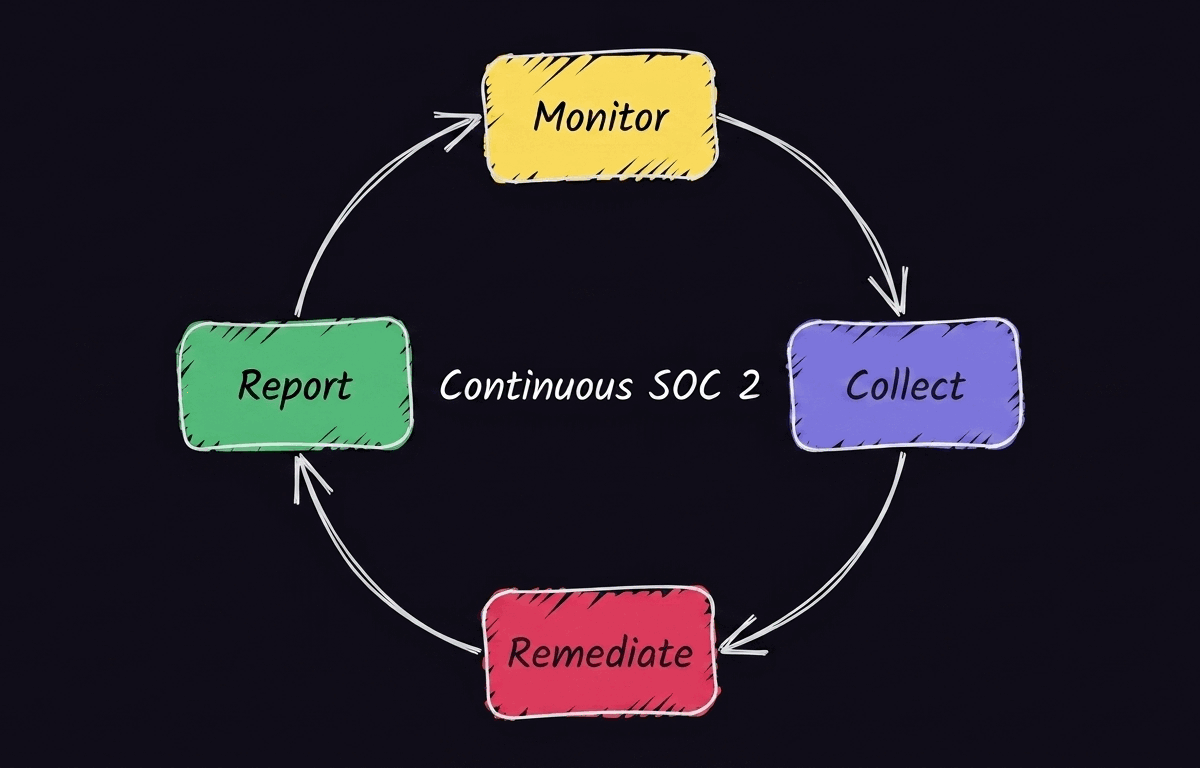
SOC 2 compliance is often viewed as a periodic audit event, but effective programs require continuous monitoring. While Governance, Risk, and Compliance (GRC) platforms provide a central repository for policies, they often struggle to connect with the fragmented reality of modern engineering stacks. This article examines how workflow orchestration tools can bridge the gap between disparate systems and compliance requirements, enabling automated evidence collection and remediation tracking.
Context and practical value
The source argues that while GRC platforms are central to SOC 2 programs, they often fail to connect with heterogeneous tech stacks. It proposes using workflow orchestration to automate evidence collection, handle data residency constraints via self-hosting, and bridge the gap between disparate systems and compliance requirements.
AtlasRepo structures the source's arguments into a practical guide for developers and compliance engineers, emphasizing the architectural role of orchestration as a control plane. It clarifies the distinction between automatable tasks and human governance, providing actionable steps for implementing these workflows.
Key takeaways
- GRC platforms often lack native integrations for custom or legacy systems, creating evidence collection gaps.
- Workflow orchestration acts as a control plane to route data from cloud providers, identity systems, and code repositories to GRC tools.
- Self-hosted orchestration solutions allow organizations to keep sensitive audit artifacts within their own infrastructure.
- Automation excels at repetitive tasks like log collection and access review scheduling but cannot replace human governance decisions.
- Event-driven workflows can automatically trigger remediation tickets when control checks fail, reducing response time.
- Continuous monitoring detects configuration drift and permission changes in real-time, rather than relying on periodic snapshots.
The Limitations of Standalone GRC Platforms
Governance, Risk, and Compliance (GRC) platforms are essential for mapping controls and managing auditor requests. However, compliance data rarely resides in a single location. Evidence is scattered across cloud infrastructure, identity providers, version control systems, and internal applications. When a GRC platform lacks native connectors for these specific tools, teams face a manual burden of exporting logs and screenshots. This fragmentation makes it difficult to maintain a continuous, up-to-date view of compliance status.
Workflow Orchestration as a Compliance Control Plane
Workflow orchestration tools can serve as an intermediary layer, or control plane, between evidence sources and GRC platforms. By building custom workflows, teams can automatically pull data from heterogeneous systems, normalize it, and push it to a central repository. This approach allows organizations to automate evidence collection without being locked into proprietary integrations. It also enables the creation of event-driven remediation processes, where failed control checks automatically generate tickets in project management tools.
Addressing Data Residency and Security Constraints
For organizations with strict security, privacy, or data residency requirements, sending compliance data to third-party SaaS platforms may not be an option. Self-hosted workflow orchestration provides a solution by allowing automation to run within the organization's own infrastructure. This ensures that audit artifacts and compliance workflows remain under the organization's control, eliminating the risk of exposing sensitive data to external vendors while still achieving automation benefits.
Defining the Boundaries of Automation
While automation can handle repetitive, rules-based tasks, it cannot replace human judgment in governance. Tasks such as defining controls, setting audit scope, evaluating vendor risk, and approving exceptions require human oversight. Automation is most effective when it reduces the operational burden of gathering information, allowing compliance and security teams to focus on strategic decision-making and risk assessment.
Practical next steps
- Audit your current tech stack to identify systems that lack native integrations with your GRC platform.
- Design workflow pipelines that automatically extract evidence from these disconnected systems and normalize the data format.
- Implement event-driven triggers to create remediation tickets in your project management tool when control checks fail.
- Evaluate self-hosted orchestration options if your organization has strict data residency or security requirements.
- Establish a continuous monitoring schedule for critical controls to detect configuration drift in real-time.
Limits and verification
- Automation cannot replace human judgment for governance decisions, risk assessment, or auditor interviews.
- Complex custom integrations may require ongoing maintenance as APIs and system configurations change.
- Self-hosted solutions require internal resources to manage infrastructure, security, and updates.
FAQ
Can SOC 2 compliance be fully automated?
No. While automation can significantly reduce manual work for evidence collection and monitoring, human judgment is still required for defining controls, approving exceptions, and making risk management decisions.
How does workflow orchestration differ from a GRC platform?
GRC platforms serve as the system of record for compliance programs, while workflow orchestration tools connect disparate systems, automate data movement, and trigger actions across the tech stack.
Is self-hosted automation necessary for SOC 2?
It is not necessary for all organizations, but it is beneficial for those with strict data residency, privacy, or security requirements that prevent using third-party SaaS platforms for compliance data.